
ZPZ is the utility token of the EZPZ Trading ecosystem, built on Polygon. This page puts every supply rule in one place: the 10 billion cap, the 5 billion burn floor, the allocation, the vesting, and where ecosystem fees go. Each number comes from the ZPZ whitepaper (version 2.3), so you can check it yourself.
Tokenomics at a Glance
| Maximum supply | 10,000,000,000 ZPZ, a hard-coded cumulative mint cap |
|---|---|
| Burn floor | 5,000,000,000 ZPZ. Burns can never take live supply below it |
| Initial on-chain mint | 1,000,000,000 ZPZ. The rest is minted in phases, always within the cap |
| Network | Polygon (POL), ERC-20, 18 decimals |
| Fee routing | Initial split of eligible ecosystem fees: 70% treasury, 20% development, 10% buyback and burn |
| Vesting | Treasury and Development: 180-day cliff, then 720 days of linear release |
| Presale price | $0.001 per ZPZ. No fixed launch price is promised |
Allocation: Where All 10 Billion ZPZ Go
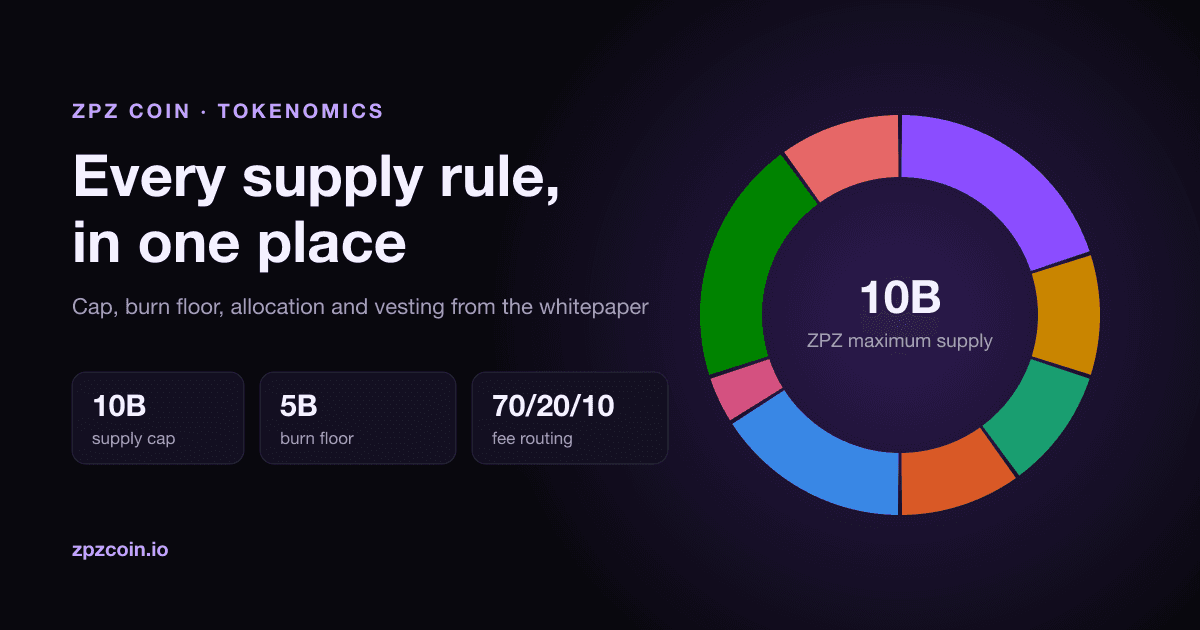
The full supply is split into eight buckets. The percentages add up to 100%, and the amounts add up to the 10 billion cap.
| Bucket | Share | Amount (ZPZ) | What it is for |
|---|---|---|---|
| Private Team Allocation | 20% | 2,000,000,000 | Completed; fully allocated |
| Public Presale | 10% | 1,000,000,000 | On-chain presale; proceeds to liquidity |
| Liquidity & DEX | 10% | 1,000,000,000 | Launch pairs; market-determined pricing |
| Staking Rewards (3 yrs) | 10% | 1,000,000,000 | The 3-year staking program |
| Treasury | 16% | 1,600,000,000 | Operations and DAO; coded vesting |
| Airdrops | 4% | 400,000,000 | Early adopters |
| Future Development | 20% | 2,000,000,000 | Upgrades, integrations, audits; coded vesting |
| Community & Marketing | 10% | 1,000,000,000 | Adoption and partnerships; small distributed rewards |
| Total | 100% | 10,000,000,000 |
To explore the same split as a chart, open the allocation ring in the whitepaper's tokenomics section.
The 5 Billion Burn Floor, in Two Examples
Burning permanently removes ZPZ from live supply, and it never restores minting capacity. Every protocol-controlled burn is checked against a hard-coded floor of 5,000,000,000 ZPZ. If a burn would take supply below the floor, the whole transaction is rejected. There is no partial fill.
- Normal burn: live supply is 8,000,000,000 ZPZ and the contract buys 250,000,000 ZPZ. All 250,000,000 is burned, and supply becomes 7,750,000,000 ZPZ.
- Floor-crossing request: live supply is 5,200,000,000 ZPZ and a 300,000,000 ZPZ burn is requested. Only 200,000,000 of burn capacity is left, so the transaction reverts and nothing is burned. The automated buyback avoids this by sizing its purchase to the capacity that remains.
Two details matter here. First, the floor does not mean 5 billion ZPZ is always minted or in circulation: issuance starts at 1 billion and grows in phases, and while supply is at or below 5 billion every protocol burn stays switched off. Second, the floor has no ordinary admin setter. Changing it would need a new audited implementation, a public timelocked multisig upgrade and a published whitepaper amendment. The floor is a supply rule. It says nothing about price.
Where Ecosystem Fees Go: 70, 20, 10
ZPZ ties token supply to real use of the ecosystem. The basis is eligible ecosystem transaction fees: what the platform actually keeps from subscriptions, AI tools, alerts, mentorships and marketplace services, after refunds, chargebacks, taxes and pass-through costs.
- 70% goes to the disclosed treasury wallet.
- 20% goes to the disclosed development wallet.
- 10% goes to a verified buyback contract, which buys ZPZ through an approved Polygon DEX router and burns it on-chain.
This is the initial split. The owner can change the percentages, as long as they total 100%, and every change is emitted on-chain. Once supply reaches the 5 billion floor, buybacks stop and the 10% share keeps accruing, recoverable only to the treasury wallet under multisig and timelock control. Each quarter's report is set to list the fee base, the three amounts, the transaction hashes, the ZPZ burned and the supply after the burn. Quarterly timing is an operational commitment, not a rule the contract enforces.
Vesting for Treasury and Development
The Treasury (1.6B) and Development (2B) allocations are locked by coded vesting in the token contract. Both follow the same schedule:
- 6-month cliff: no tokens are accessible for the first 180 days.
- 24-month linear release: after the cliff, tokens vest continuously over 720 days.
- No early release: unvested tokens are excluded from every owner recovery and emergency function.
A calendar start date for these schedules has not been published yet. You can drag through the release curve, day by day, in the whitepaper's vesting section.
Guardrails After DEX Launch
- Launch sell cap: for the first 60 days after DEX launch, non-whitelisted holders can move out at most 1% of their holdings per day. Deposits into staking are exempt.
- Protected wallets: Treasury, Development and full maturity-release recipients are paced at 1% per day and 10% per 30 days of their tracked freed amount, with no expiry.
- Anti-bot limits: 50,000,000 ZPZ per transaction, 500,000,000 ZPZ per wallet, a 30-second sender cooldown and 3 sender transactions per 5 minutes.
- Quadratic governance: voting credits equal the square root of staked ZPZ, so 100 times the stake gives 10 times the votes. Only staked tokens vote, and unstaked Treasury and Development balances carry no voting power.
Five Questions to Ask Any Token, Answered for ZPZ
Before you look at any token, these five questions tell you most of what you need. Here are the answers for ZPZ, straight from the whitepaper.
- Is the supply capped? Yes. The contract counts every token ever minted against a 10,000,000,000 ZPZ cap, and that counter only goes up. Burning never frees room to mint more.
- How much went to insiders, and is it locked? The Private Team Allocation is 20%, listed as completed and fully allocated. Treasury (16%) and Future Development (20%) carry coded vesting. The whitepaper does not describe coded vesting for the other buckets.
- Can the team change the rules? Some, and it says which. The fee split and recipient wallets are owner-configurable, with every change emitted on-chain. The burn floor and the supply cap have no ordinary setter. Mint and upgrade authority sits with the owner and is intended to be held under a multisig and timelock; the project will publish the multisig address, signer threshold and timelock delay before production use.
- Who audited the code? CredShield. The initial audit is complete, and a full re-audit of the final contracts is in progress. The final report and audited commit hash will be published before DEX launch.
- Can I verify it myself? That is the plan. The token, staking, DAO and buyback contract addresses will be published and source-verified on PolygonScan before DEX launch, so every parameter on this page, including the 5B floor, can be checked on-chain.
Staking
10% of supply (1,000,000,000 ZPZ) funds a 3-year staking program for active ecosystem participants. Its terms, including the participation bonus and the maturity release schedule, are set out in full in the whitepaper's staking section.
Read the Full Rules
- Read the ZPZ whitepaper for every contract parameter.
- See the launch roadmap for target dates.
- Read the ZPZ FAQs for common questions.
- Read what ZPZ Coin is designed to do inside EZPZ Trading.